 Skip to content

Amazon FBA Fees
Understanding Amazon’s fee structure is the difference between a profitable business and a costly hobby. In 2026, Amazon introduced significant updates to its Fulfillment by Amazon (FBA) fees, including new size tiers, increased fulfillment rates, and stricter inventory penalties.
This guide provides a complete, transparent breakdown of every cost you will encounter when selling on Amazon in 2026. We will move beyond the basics to explain exactly how these fees are calculated and, more importantly, how you can optimize your operations to minimize them.
The 5 Core Components of Amazon FBA Fees
Amazon’s fees can be categorized into five main buckets. Understanding how these interact is crucial for accurate profit forecasting.
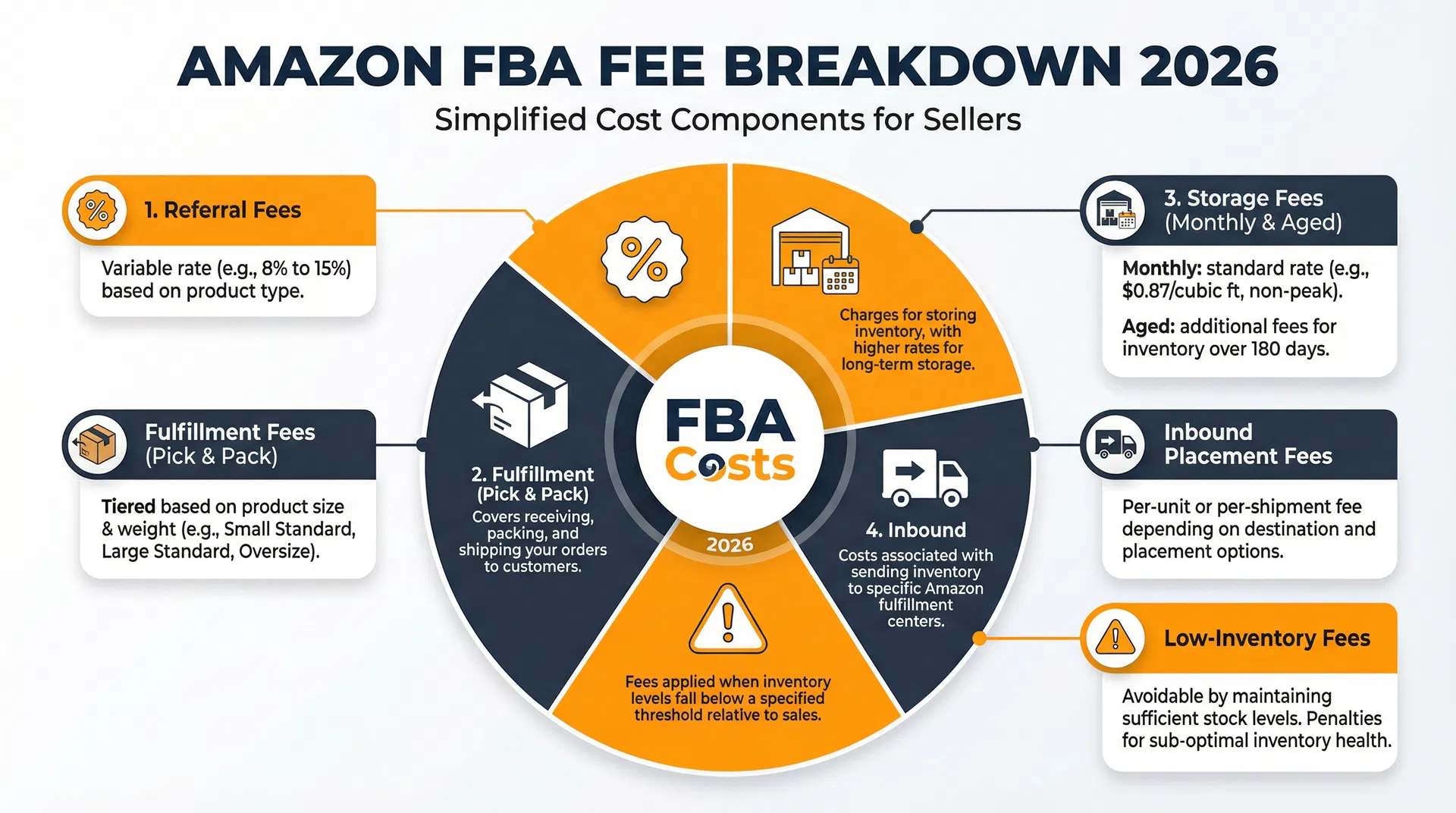
1. Referral Fees (The “Commission”)
This is the fee Amazon charges for the privilege of selling on their marketplace. It is calculated as a percentage of the total sales price (including shipping and gift wrap charges).
- Standard Rate: Typically 15% for most categories.
- Electronics: Often lower, around 8%.
- Clothing & Accessories: Can be 17%.
- 2026 Update: Referral fees remain largely stable, but watch for category-specific promotions.
2. FBA Fulfillment Fees (Pick & Pack)
This fee covers the cost of picking your item from the shelf, packing it, and shipping it to the customer. It is determined by the size tier and shipping weight of your product.
2026 Fee Increases:
Effective January 15, 2026, fulfillment fees have increased to account for rising logistics costs.
| Product Size Tier | Price Range | 2026 Fee Increase (Avg) |
|---|---|---|
| Small Standard (≤ 12 oz) | $10 – $50 | +$0.25 per unit |
| Large Standard (≤ 3 lb) | $10 – $50 | +$0.31 per unit |
| Large Standard (> 3 lb) | > $50 | +$0.72 per unit |
- Pro Tip: If your product is on the borderline of a size tier (e.g., 12.1 oz), reducing the packaging weight by just 0.2 oz could save you over $0.50 per unit sold.
3. Storage Fees (Monthly & Aged)
Amazon is not a long-term storage facility. Their fee structure incentivizes rapid inventory turnover.
- Monthly Inventory Storage Fees: Charged between the 7th and 15th day of the month following the month for which the fee applies.
- Jan – Sept: ~$0.87 per cubic foot (Standard size).
- Oct – Dec (Peak): ~$2.40 per cubic foot.
- Aged Inventory Surcharge: Previously known as Long-Term Storage Fees. Inventory stored for more than 180 days incurs massive surcharges. In 2026, these fees have become even more aggressive to clear out fulfillment center space.
4. Inbound Placement Fees
Introduced recently, this fee charges sellers for sending inventory to a single fulfillment center (which forces Amazon to redistribute it).
- How to Avoid It: You can reduce or eliminate this fee by splitting your shipment into multiple shipments sent to different fulfillment centers across the country (Amazon’s “Optimized Shipment Split”).
5. Low-Inventory-Level Fees
This is a critical 2026 update. Amazon now penalizes sellers who consistently run low on stock relative to their sales velocity.
- The Rule: If your historical days of supply is less than 28 days, you will be charged a per-unit fee.
- Why? Low inventory forces Amazon to ship from further away, increasing their costs.
- Strategy: Maintain a healthy buffer stock. Do not let your inventory dip below 4 weeks of cover.
Real-World Calculation Example
Let’s calculate the fees for a hypothetical product: A Wireless Mouse selling for $29.99.
- Product Weight: 6 oz
- Dimensions: Small Standard Size
- Category: Consumer Electronics
| Fee Type | Calculation | Cost |
|---|---|---|
| Referral Fee | 15% of $29.99 | $4.50 |
| FBA Fulfillment Fee | Small Standard (6 oz) | $3.86 |
| Monthly Storage | Est. 0.02 cu. ft. x $0.87 | $0.02 |
| Total Amazon Fees | $8.38 | |
| Net Proceeds | $29.99 – $8.38 | $21.61 |
Note: This does not include your Cost of Goods Sold (COGS), advertising (PPC), or inbound shipping costs.
How to Reduce Your Amazon FBA Fees in 2026
You cannot control the rate card, but you can control how your product fits into it.
- Optimize Packaging: Shaving fractions of an inch or ounce can drop you into a lower fee tier. Use the FBA Revenue Calculator to test different dimensions.
- Audit Your Inbound Strategy: Use Amazon’s “Optimized Shipment Split” to avoid placement fees, even if it means a slightly more complex prep process.
- Manage Inventory Health: Use the “FBA Inventory Age” report to identify slow movers. Liquidate or remove inventory before it hits the 180-day mark to avoid aged inventory surcharges.
- Bundle Products: Selling a 2-pack increases your average order value (AOV) while only incurring one fulfillment fee (though weight increases, the relative cost often decreases).
Conclusion
Amazon FBA fees in 2026 are higher and more complex, but they are manageable with the right strategy. By understanding the nuances of size tiers, placement fees, and inventory health, you can protect your margins and build a sustainable business.
Need help auditing your FBA fees?
Prolific Zone offers comprehensive account audits to identify hidden fee leaks and optimization opportunities. Contact our team to ensure you aren’t overpaying Amazon.