 Skip to content

How to Sell on Amazon FBA in 2026
Selling on Amazon FBA (Fulfillment by Amazon) has evolved dramatically. What worked in 2020—or even 2024—is now obsolete. In 2026, the marketplace is driven by AI search algorithms, stricter inventory policies, and a demand for premium brand experiences.
If you are looking to build a scalable e-commerce business this year, you cannot rely on outdated “get rich quick” tactics. You need a data-driven, professional strategy that accounts for the latest fee structures and operational shifts.
This guide is your definitive roadmap. We will cover everything from the critical 2026 policy updates to a proven 7-step launch strategy that positions your brand for long-term dominance.
What is Amazon FBA?
Fulfillment by Amazon (FBA) is a service that allows third-party sellers to automate their order fulfillment and shipping services. It is simple in concept but powerful in execution:
- You sell it: You list your products on Amazon.
- Amazon ships it: You send your inventory to Amazon’s fulfillment centers.
- Amazon handles the rest: When a customer buys your product, Amazon picks, packs, ships, and provides customer service.
By using FBA, your products become eligible for Amazon Prime free two-day shipping, a critical factor for winning the Buy Box and converting shoppers.
Critical Updates for Sellers in 2026
Before you source your first product, you must understand the new landscape. 2026 has introduced significant changes that impact profitability and operations.
1. The End of Amazon FBA Prep Services
Effective January 1, 2026, Amazon has discontinued its in-house FBA prep and labeling services for the US store. This is a massive shift for sellers who previously relied on Amazon to bubble wrap, bag, or label their inventory.
- The Impact: You must now ensure all inventory is 100% compliant before it reaches an Amazon fulfillment center.
- The Solution: You need to handle prep in-house, work with your manufacturer to prep goods at the source, or hire a third-party logistics (3PL) provider.
- Risk: Non-compliant shipments may be rejected or incur heavy “unplanned prep” fees.
2. 2026 Fee Increases
Fulfillment fees have seen a moderate increase to account for rising logistics costs.
- Standard-size products: Fees have increased by an average of $0.08 to $0.25 per unit, depending on the price tier.
- Storage Fees: While monthly storage fees remain stable, aged inventory surcharges have become more aggressive. Inventory turnover is more critical than ever.
3. Stricter Capacity Limits
Amazon’s capacity management system now penalizes sellers with low Inventory Performance Index (IPI) scores more severely. New sellers must rapidly prove their sell-through rate to unlock higher storage limits.
The 7-Step Amazon FBA Launch Roadmap (2026 Edition)
Success on Amazon is a process, not an event. Follow this proven roadmap to minimize risk and maximize ROI.
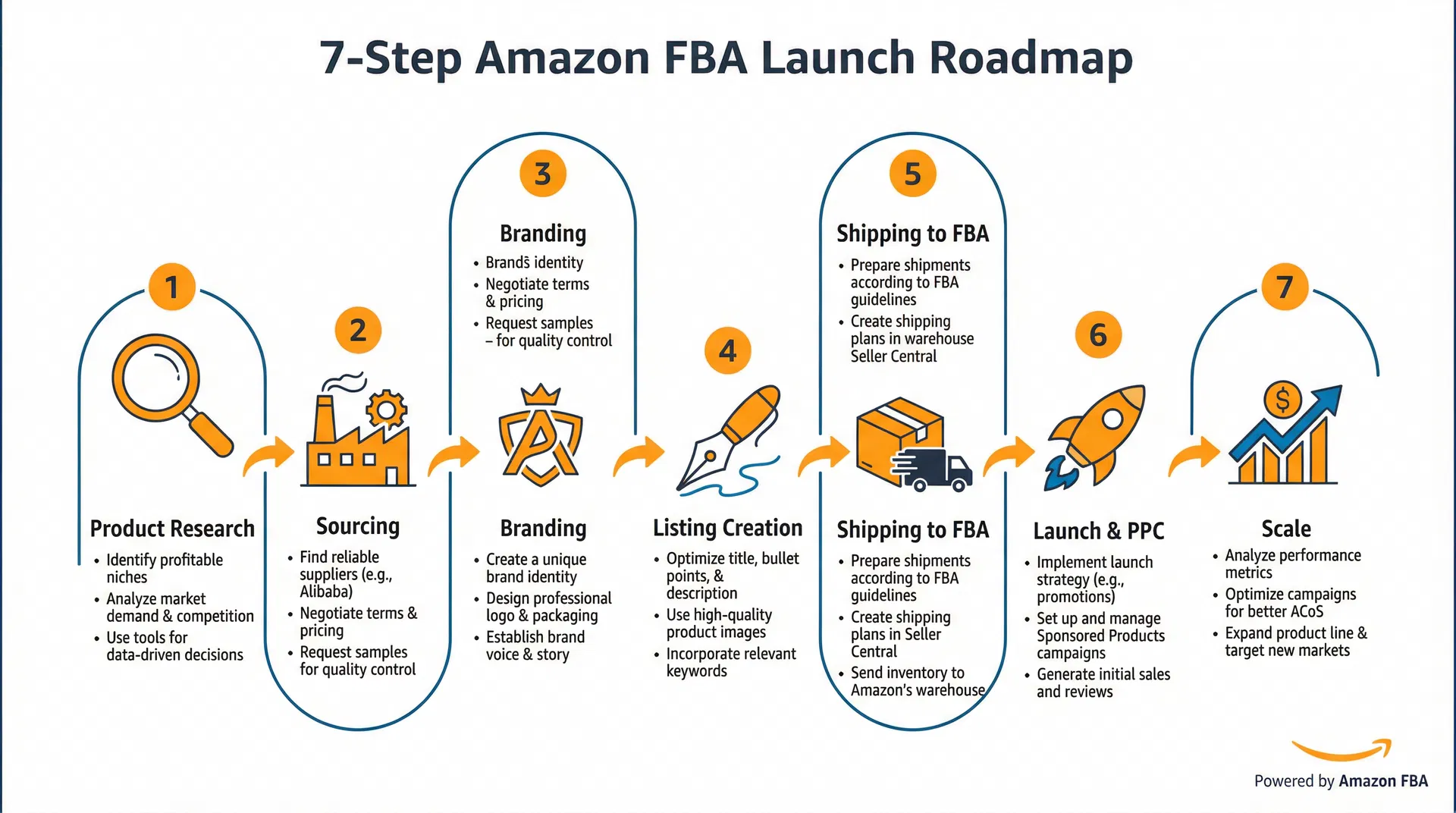
Step 1: Data-Driven Product Research
Forget “passion products.” In 2026, you sell what the data tells you to sell.
- Look for Demand: Use tools like Helium 10 or Jungle Scout to find keywords with high search volume (3,000+ monthly searches) but relatively low competition.
- Analyze Reviews: Read competitor reviews to find “market gaps”—complaints about quality or features that you can fix.
- Profitability Check: Ensure your margin is at least 30% after all fees (COGS, FBA fees, referral fees, and PPC costs).
Step 2: Strategic Sourcing
Most sellers source from China via Alibaba, but 2026 trends are shifting toward diversification.
- Verify Suppliers: Always use Trade Assurance. Look for manufacturers with 3+ years of history.
- Negotiate Terms: Don’t just accept the first price. Negotiate on MOQ (Minimum Order Quantity) and unit cost.
- Quality Control: Crucial Step. Hire a third-party inspection service in China to check your goods before they ship. You cannot afford to send defective units to Amazon.
Step 3: Branding & Differentiation
Generic products are dead. To survive, you must build a brand.
- Brand Identity: Create a professional logo and packaging design.
- Differentiation: Bundle your product with a complementary item, improve the material, or solve a specific pain point found in competitor reviews.
- Trademark: Apply for a trademark immediately to enroll in Amazon Brand Registry. This unlocks A+ Content and protection against hijackers.
Step 4: Listing Optimization (GEO-Ready)
Your listing needs to appeal to both humans and AI search engines (Generative Engine Optimization).
- Title: Include your main keywords naturally. Focus on benefits, not just features.
- Bullet Points: Write persuasive copy that addresses customer pain points.
- Images: Invest in professional photography. You need a hero image on a pure white background, plus lifestyle shots and infographics.
- A+ Content: Use rich visuals to tell your brand story and cross-sell other products.
Step 5: Shipping to FBA (The New Way)
With the end of Amazon’s prep services, this step requires precision.
- Create a Shipping Plan: In Seller Central, tell Amazon exactly what you are sending.
- Prep & Label: Ensure every unit has an FNSKU barcode. If your manufacturer can’t do this, use a 3PL.
- Shipping Method: For your first shipment, Air Express is faster but more expensive. Sea freight is better for margins on larger orders.
Step 6: Launch & PPC Strategy
You can’t just list it and wait. You need traffic.
- Amazon PPC: Start with Sponsored Products campaigns. Target the specific keywords you identified in Step 1.
- Vine Program: Enroll in Amazon Vine to get your first up to 30 reviews legally.
- Honeymoon Period: Amazon gives new products a boost in the first 30 days. Aggressive PPC during this window is critical to establish rank.
- Learn more in our Ultimate Guide to Amazon PPC Advertising (2026).
Step 7: Scale & Optimize
Once sales are flowing, it’s time to optimize.
- Analyze Reports: Cut wasted ad spend on keywords that don’t convert.
- Inventory Management: Don’t run out of stock. Stockouts kill your ranking.
- Expand: Launch variations (colors, sizes) or complementary products to build a catalog.
- Consider advanced strategies like Amazon DSP to retarget shoppers off-Amazon.
Frequently Asked Questions (FAQ)
Is Amazon FBA still profitable in 2026?
Yes, but the barrier to entry is higher. The “easy money” days are gone.
Profitability now requires strict inventory management, brand differentiation, and professional PPC management.
How much money do I need to start an Amazon FBA business?
We recommend a starting budget of $3,000 to $5,000.
This covers your initial inventory, product samples, branding, tools, and initial PPC budget.
Can I sell on Amazon without FBA?
Yes, this is called FBM (Fulfillment by Merchant).
However, FBM sellers are often at a disadvantage because they don’t automatically qualify for the Prime badge, which significantly lowers conversion rates.
What is the difference between Amazon FBA and Walmart WFS?
Both offer similar fulfillment services, but Walmart WFS is less saturated and offers lower storage fees. Many successful sellers now sell on both platforms.
- Read our full comparison: Walmart WFS vs Amazon FBA: Which is Best in 2026?
Conclusion On How to Sell on Amazon FBA
Selling on Amazon FBA in 2026 is a serious business opportunity that rewards professionalism and data-driven decision-making. By understanding the new fee structures, taking control of your prep process, and following a structured launch roadmap, you can build a brand that generates consistent revenue.
Ready to take your Amazon business to the next level?
Prolific Zone helps brands scale with expert PPC management, listing optimization, and full-service agency support. Contact us today for a free audit of your potential.