 Skip to content

Selling on Amazon.com from Europe
For European brands, the United States represents the ultimate growth frontier. With over 300 million active customers and a Prime membership base that dwarfs any single European country, Amazon.com is not just a marketplace—it is an economy unto itself.
However, crossing the Atlantic involves more than just shipping products. In 2026, the regulatory landscape has shifted. From new US sales tax nexus laws to stricter FDA compliance for consumables, the barrier to entry is higher, but the rewards are greater.
This guide is your strategic blueprint for successfully launching your European brand on Amazon US in 2026.
Why Expand to the US in 2026?
The European e-commerce market is fragmented. Selling in Germany, France, and Italy requires translating listings into three languages, navigating three different VAT systems, and managing culturally distinct customer service expectations.
In contrast, the US offers:
- Single Language: One set of listing copy reaches 330 million people.
- Unified Logistics: FBA inventory placed in New Jersey can reach a customer in California in two days without crossing a single border.
- Higher Spending Power: The average US Prime member spends significantly more annually than their European counterparts.
The 5-Step Launch Roadmap
Expanding to the US requires a systematic approach. We have broken down the complex process into five actionable steps.
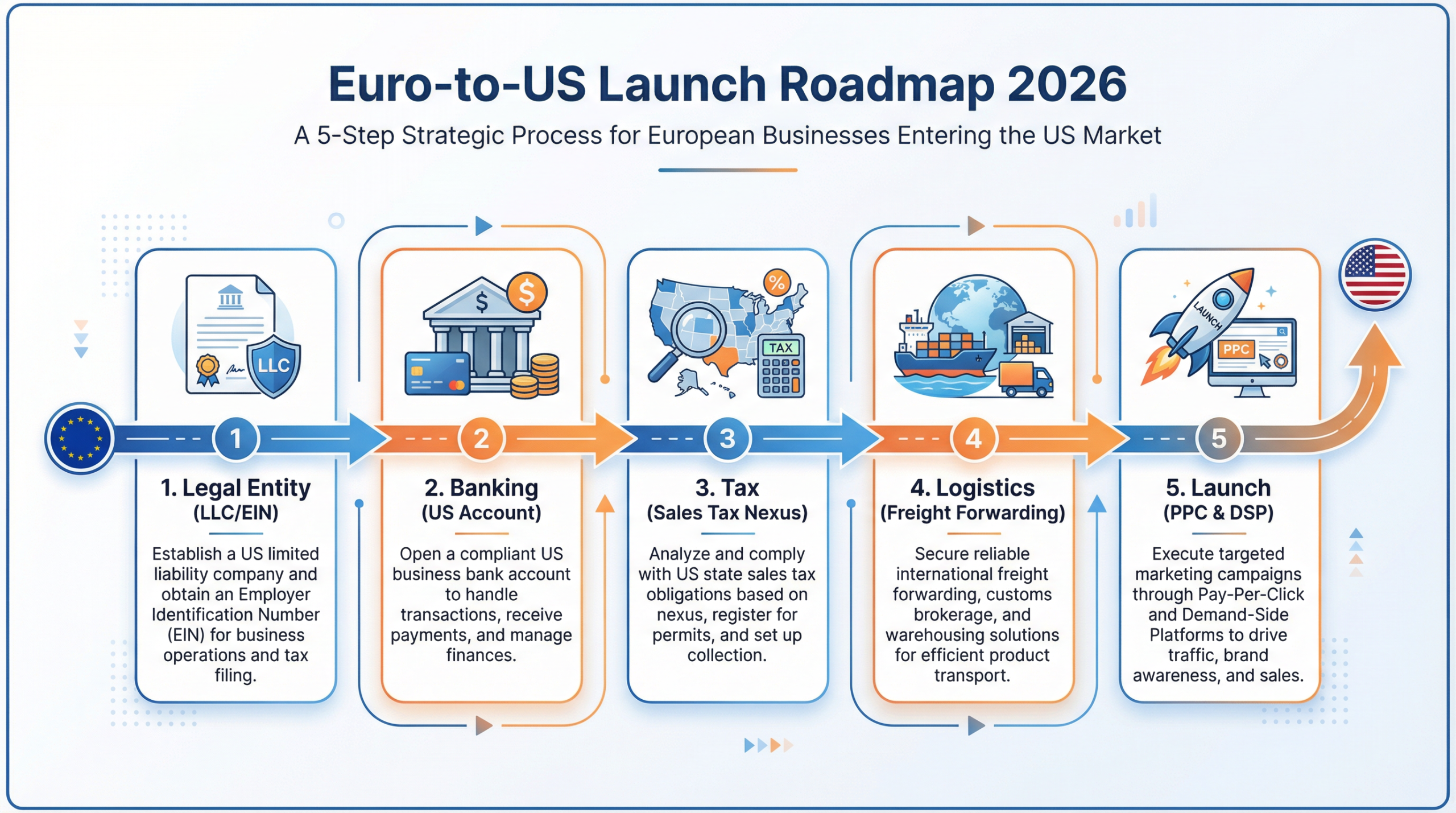
Step 1: Legal Entity & Account Setup
You do not strictly need a US company to sell on Amazon.com, but in 2026, it is highly recommended for liability protection and tax efficiency.
- LLC Formation: Most European sellers choose to form a Limited Liability Company (LLC) in states like Wyoming or Delaware due to their business-friendly laws and low maintenance costs.
- EIN Acquisition: Once your LLC is formed, you must obtain an Employer Identification Number (EIN) from the IRS. This number is your business’s tax ID and is required to open a US bank account.
- Amazon Global Selling: You can link your existing European Seller Central account to a new North American account using Amazon’s “Global Selling” dashboard. This allows you to view all your global sales in one place, though the accounts remain technically separate entities.
Step 2: Banking & Currency Management
Amazon pays out in US Dollars (USD). If you connect your European bank account directly, Amazon will convert the funds at a rate that often includes a 3-4% markup.
- Virtual US Bank Accounts: Services like Payoneer, Wise, or Airwallex allow you to open a receiving account in the US. This gives you a legitimate US routing and account number.
- Strategy: Receive funds in USD, pay your US suppliers and PPC costs in USD, and only convert profit back to Euros when the exchange rate is favorable. This “natural hedging” can save you thousands in fees annually.
Step 3: Navigating US Sales Tax
Unlike European VAT, which is a federal tax included in the price, US Sales Tax is a state-level tax added on top of the price.
- The “Nexus” Concept: You are only required to collect sales tax in states where you have a “nexus” (a significant presence).
- Marketplace Facilitator Laws: The good news for 2026 is that Amazon now collects and remits sales tax on your behalf for almost all US states. This massively simplifies compliance for FBA sellers.
- Inventory Nexus: Be aware that storing inventory in a state (e.g., an Amazon warehouse in Texas) technically creates a nexus. While Amazon handles the collection, you may still need to register for a sales tax permit in that state.
Step 4: International Logistics (Freight Forwarding)
Shipping to the US is different from shipping within the EU. You become the “Importer of Record” (IOR), meaning you are legally responsible for the goods entering the country.
- Customs Bond: You will need to purchase a customs bond (either single-entry or continuous) to clear your goods through US Customs and Border Protection (CBP).
- DDP Shipping: Always ship “Delivered Duty Paid” (DDP). This ensures that all duties and taxes are paid before the goods arrive at Amazon. If you ship “Delivered Duty Unpaid” (DDU), Amazon will reject the shipment at the dock.
- 3PL vs. Direct to FBA: In 2026, Amazon’s capacity limits are strict. Many European sellers use a US-based Third-Party Logistics (3PL) provider to store bulk inventory and drip-feed it into FBA warehouses as needed.
Step 5: Launch & Marketing
The US market is hyper-competitive. Strategies that work in smaller European markets (like low bids or basic listings) will fail here.
- Aggressive PPC: Expect Cost Per Click (CPC) to be 30-50% higher than in Europe. You must budget for an aggressive launch phase where ACoS (Advertising Cost of Sales) may exceed 100% to build ranking.
- US-Specific Copywriting: British English is not American English. “Trousers” are “Pants”; “Torches” are “Flashlights.” Hire a US-based copywriter to localize your listings, or you will miss out on high-volume keywords.
- Full-Funnel Approach: Utilize Amazon DSP (Demand Side Platform) to retarget shoppers who viewed your product but didn’t buy. In a mature market like the US, retargeting is often the difference between profit and loss.
Conclusion: The American Dream is Open for Business
Expanding to Amazon.com is the single biggest lever you can pull to scale your e-commerce business. The operational hurdles—taxes, customs, banking—are solvable with the right partners.
The real challenge is the competition. To win in the US, you need a partner who understands the terrain.
Ready to cross the ocean? Contact Prolific Zone for a comprehensive US expansion audit. We help European brands navigate the complexities of the American market and scale with confidence.