 Skip to content

Walmart WFS vs. Amazon FBA: A Tale of Two Giants
For over a decade, “Fulfillment by Amazon” (FBA) was the only game in town for serious e-commerce brands. If you wanted prime shipping speeds and customer trust, you paid the “Amazon Tax” and accepted it.
But in 2026, the script has flipped. Walmart Fulfillment Services (WFS) has matured from a clunky alternative into a streamlined, cost-effective powerhouse that is actively poaching sellers from the Amazon ecosystem.
This isn’t just about diversifying revenue streams anymore—it’s about survival. With Amazon’s 2026 fee hikes introducing complex “granularity” based on price tiers and inventory age, many sellers are seeing their margins evaporate.
Meanwhile, Walmart is playing the long game, keeping fees simple and offering “Blue Ocean” opportunities for brands willing to leap.
In this definitive guide, we break down the Walmart WFS vs. Amazon FBA battle for 2026. We’ll analyze the hidden costs, the logistical differences, and why a “Hybrid Strategy” might be your most profitable move this year.
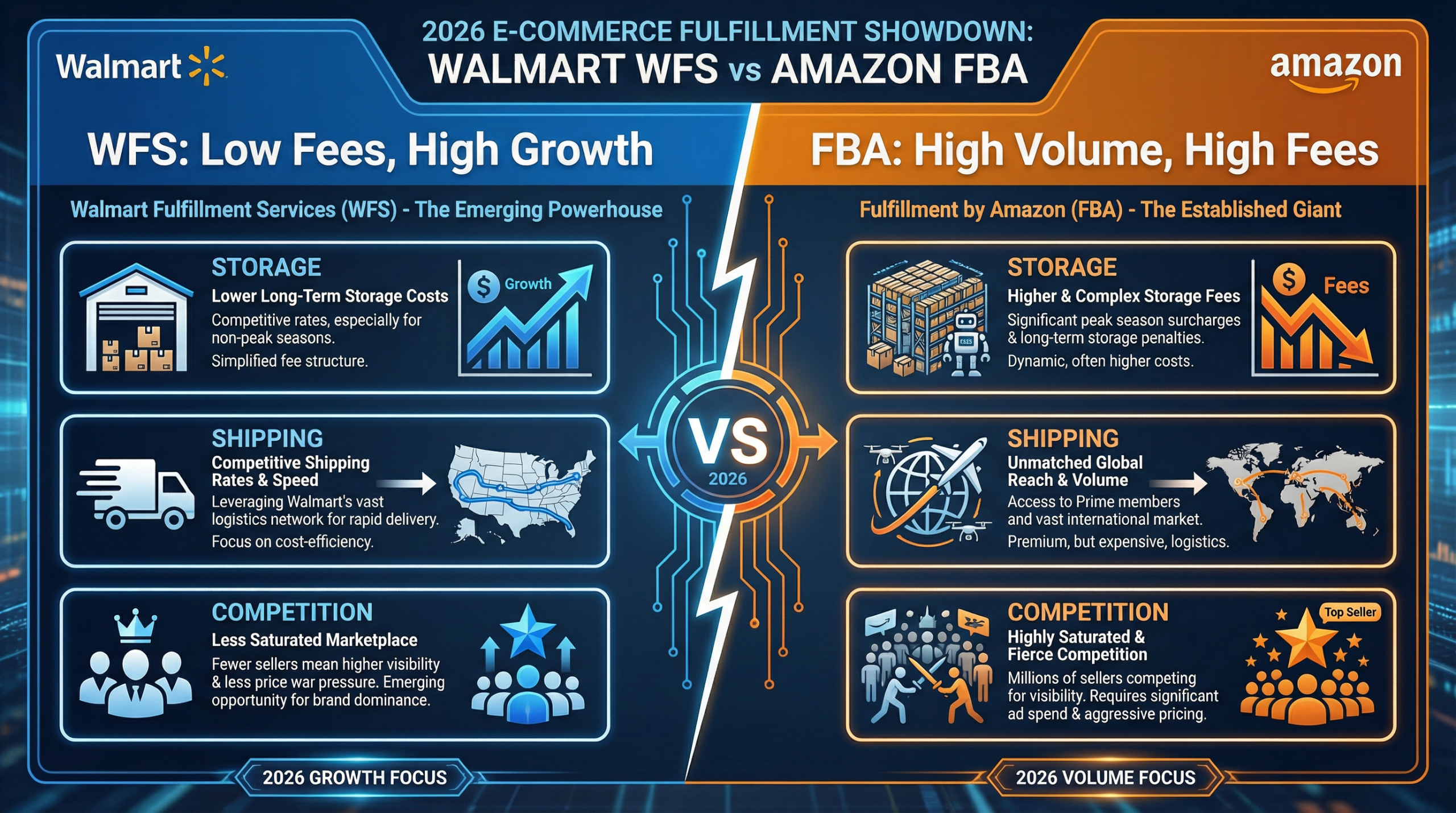
1. The Cost of Doing Business: 2026 Fee Breakdown
The most immediate difference between the two platforms is how they charge you. Amazon has moved toward a highly complex, variable model, while Walmart has doubled down on simplicity.
Amazon FBA: The “Granularity” Trap
In 2026, Amazon introduced a fee structure that punishes inefficiency and low-priced items.
- Price Tiers: Fees now change drastically based on your selling price. Items over $50 face a surcharge (avg. +$0.31 to +$0.51/unit), while items under $10 get a discount but still saw a base rate hike of $0.05/unit.
- The “Sale” Penalty: If you run a promotion that drops your price from $51 to $49, your entire fulfillment fee structure changes, often eating into the profit you thought you were protecting.
- Peak Storage: Q4 storage fees have hit a staggering $2.40 per cubic foot, with new surcharges for inventory aged just 15 months.
Walmart WFS: The Weight-Based Advantage
Walmart’s fee structure remains refreshingly straightforward, focusing on weight rather than price.
- Simple Tiers: A 1lb item costs approximately $3.45 to ship. A 2lb item is $4.95.
- Price Agnostic: Whether you sell a $20 tool or a $100 gadget, if they weigh the same, the fulfillment fee is the same. This makes WFS incredibly profitable for high-ticket items.
- Storage Savings: Standard storage is roughly $0.75 per cubic foot—less than a third of Amazon’s peak rate. Plus, Walmart historically waives peak storage fees for new sellers to encourage catalog expansion.
Winner: Walmart WFS for high-ticket and simple fee management. Amazon FBA for ultra-light, high-volume items under $10.
2. The “Blue Ocean” Opportunity: Competition & Visibility
Fees are only half the story. The other half is whether customers actually see your product.
Amazon: The Red Ocean
Amazon is a mature, saturated market. A popular search term might yield 50+ competitive offers on the first page.
- Ad Spend Reliance: To be seen, you almost have to pay for PPC. Organic reach is shrinking as ad slots take over the top of search results.
- Price Wars: With so many sellers on the same listing, automated repricers drive margins to the floor within hours.
Walmart: The Blue Ocean
Walmart Marketplace is where Amazon was in 2015—growing fast, but not yet crowded.
- Less Competition: That same popular product might only have 2-5 sellers on Walmart.
- The “Pro Seller” Boost: Using WFS automatically qualifies you for the “Pro Seller” badge (Walmart’s version of Prime). Because fewer sellers have this badge compared to Prime, your listing stands out dramatically in search results.
- Higher Margins: With less competition, there is less downward pressure on price. We often see the same SKU selling for 10-15% more on Walmart than on Amazon.
Winner: Walmart WFS. The ability to own the Buy Box without aggressive ad spend is a massive advantage in 2026.
3. Logistics & Requirements: Getting Your Goods There
Amazon FBA: The Global Machine
Amazon’s logistics network is unmatched. They can deliver to almost any doorstep in America in 24 hours.
- Pros: Incredible speed, global reach, and a “hands-off” experience once inventory is checked in.
- Cons: Strict inbound requirements. One wrong label or box dimension can lead to rejected shipments and account health strikes.
Walmart WFS: The Rising Challenger
Walmart leverages its massive network of physical stores and distribution centers.
- Pros: You can often drop off inventory at select hubs, bypassing some shipping costs. Their “Preferred Carrier” rates are becoming very competitive.
- Cons: Stricter approval process. You can’t just “sign up” for WFS; you often need to apply and prove you have a track record. They also have stricter prohibitions on certain product categories compared to Amazon.
Winner: Amazon FBA for pure logistical speed and ease of entry. Walmart WFS for cost-efficiency on domestic inventory.
4. The Verdict: Why You Need a Hybrid Strategy
The debate shouldn’t be “Walmart WFS vs. Amazon FBA” In 2026, the winning strategy is “WFS and FBA.”
- Use Amazon for Volume: It’s still the traffic king. Launch products here to get velocity and cash flow.
- Use Walmart for Profit: Move your best-sellers and high-ticket items to WFS. Enjoy the lower fees, higher margins, and lack of competition.
How Prolific Zone Can Help
Managing two distinct fulfillment ecosystems is complex. You need to balance inventory levels, navigate two different sets of fee structures, and optimize ads on both platforms.
At Prolific Zone, we specialize in this Hybrid Management. We don’t just run your ads; we analyze your entire catalog to tell you exactly which SKUs should be on Amazon, which should be on Walmart, and which should be on both.
Ready to start growing on Amazon and Walmart?
Contact us today for a free audit.
Frequently Asked Questions (FAQ)
Is Walmart WFS cheaper than Amazon FBA?
Generally, yes. For items over 1lb and priced over $50, WFS is significantly cheaper due to its simple weight-based fees and lack of “high-price” surcharges.
Do I need a separate account for WFS?
Yes, you must apply and be approved for a Walmart Marketplace account, and then apply specifically for WFS. It is not automatic like FBA.
Can I use WFS to fulfill Amazon orders?
No. Walmart strictly prohibits using WFS to fill orders from competitor marketplaces (like Amazon or eBay). You must keep inventory separate.